February 24, 2010
Questions and Answers About Animal Testing of Chemicals
Overview | Take Action | Q&A: Pesticides | Q&A: Endocrine Disrupters
- What kinds of chemicals are candidates for testing?
- How are chemicals regulated in the United States?
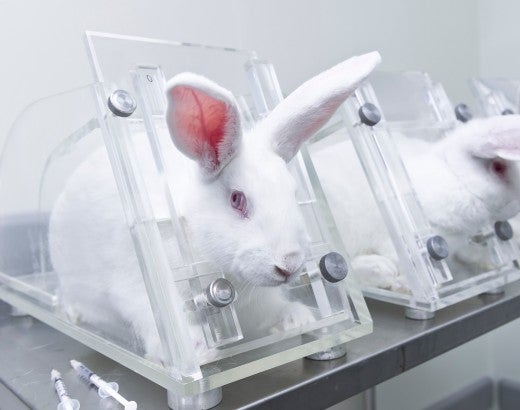
- How are animals used to test chemicals?
- Are animals used in testing given pain relief or other protections?
- Besides animal welfare, are there other arguments against testing on animals?
- What are some practical alternatives to using animals to test chemicals?
- What are HSUS and HSLF doing to spare animals from chemical testing?
- How can I help?
Q: What kinds of chemicals are candidates for testing?
A: It's estimated that at least 80,000 chemicals are currently in commercial use in the United States, with up to 700 new chemicals being introduced each year. Most are ingredients used in plastics and related polymers, while a smaller proportion are used in cleansers, paints, adhesives, lubricants, industrial solvents and a variety of short-lived by-products or "intermediates." Some are kept tightly contained in closed systems and never released into the environment, while others may be marketed in high volumes and/or used as ingredients in products to which humans and the environment may be exposed (e.g., cosmetics and household cleaning products, plastic packaging, and gasoline).
Q: How are chemicals regulated in the United States?
A: The U.S. law that deals most directly with the safety assessment and testing of chemicals is the Toxic Substances Control Act of 1976 (TSCA), which is administered by the Environmental Protection Agency (EPA). TSCA grants the EPA limited powers to assess chemicals before they are sold to consumers (new chemicals) and to review those chemicals already available (existing chemicals).
In addition to its legal powers under TSCA, the EPA has, in partnership with the chemical industry and environmental groups, created the following voluntary programs to gather chemical toxicity information:
- High Production Volume Chemical Challenge Program
- Extended High Production Volume Program
- Voluntary Children's Chemical Evaluation Program
- Nanoscale Materials Stewardship Program
- Chemical Assessment and Management Program
The agency is also in the process of implementing its Endocrine Disruptor Screening Program, which may lead to extensive new animal testing of chemicals used as ingredients in pesticides, as well as chemicals found in rivers, lakes and drinking water.
Recognizing the limitations of TSCA, Members of Congress have in recent years sought to fundamentally reform the legislation, most notably via a federal bill called the Kid Safe Chemicals Act.
Q: How are animals used to test chemicals?
A: The former Environmental Protection Agency (EPA) High Production Volume (HPV) Chemical Challenge Program, Extended HPV Program and Chemical Assessment and Management Program have prescribed a "screening information data set" consisting of lethal poisoning tests in rodents and fish, as well as 28-day repeated dosing test, gene mutation and reproductive/developmental toxicity tests. Altogether, nearly 800 animals are used to test each chemical. Voluntary Children's Chemical Evaluation Program information requirements are the same as those above, but often more extensive. Under the Nanoscale Materials Stewardship Program, the EPA has requested submission of "all relevant information that is known or reasonably ascertainable," including data concerning human health and environmental effects, but has not yet called for specific animal tests to be conducted. Information regarding the EPA's Endocrine Disruptor Screening Program is available here.
In contrast, the most recent version of the Kid Safe Chemicals Act (110th Congress) proposes to borrow the legal safety standard currently applied to pesticides, which could mean that each chemical could be subject to dozens of separate animal studies, in total consuming and as many as 12,000 animals. If such an extravagant testing approach were to be applied to the estimated 80,000 industrial chemicals currently in commercial use, the implications in terms of number of animals being poisoned and killed in laboratory toxicity tests would be unprecedented.
Q: Are animals used in testing given pain relief or other protections?
A: No, pain relief is not normally provided. And to make matters worse, laboratory-bred rodents and fish—the species most commonly used in chemical tests—are not protected under U.S. law governing animal experimentation.
Q: Besides animal welfare, are there other arguments against testing on animals?
A: Yes, there are a number of points to consider. Most animal tests have never been properly "validated" to demonstrate their relevance to humans, and as a result may under- or over-estimate real-world hazards to people. For example, both rat and rabbit tests failed to predict the birth defect-causing properties of PCBs, industrial solvents and many drugs, while cancer tests in rats and mice failed to detect the hazards of asbestos, benzene, cigarette smoke, and many other substances—delaying consumer and worker protection measures by decades in some cases.
Animal tests are also quite time- and resource-intensive and inefficient. To evaluate the cancer-causing potential of a single pesticide chemical in a standard rat and mouse study test takes up to five years, 800 animals, and $4 million, yet for the same price and without any use of animals, as many as 350 chemicals could be tested in less than a week in 200 different cell tests using modern robotics. In order to process the backlog of existing chemicals already in use, as well as new substances, regulators need timely access to reliable and relevant toxicity information, which animal tests cannot provide.
Q: What are some practical alternatives to using animals to test chemicals?
A: More than two-dozen non-animal or animal-reduction methods and testing strategies have been endorsed as scientifically "validated" by the European Centre for the Validation of Alternative Methods and its counterparts worldwide. Additionally, movement away from rigid "check-the-box" lists of animal tests in favor of flexible testing strategies could have a dramatic impact on reducing animal use.
Q: What are The Humane Society of the United States and The Humane Society Legislative Fund doing to spare animals from chemical testing?
A: Our scientists and policy experts are working with the Environmental Protection Agency and its counterparts worldwide to shorten the time between the development of alternative testing methods and their real-world application to replace or reduce animal use in chemical testing. We are also actively engaged in political discussions surrounding Toxic Substances Control Act of 1976 reform and the Kid Safe Chemicals Act to ensure that any new federal legislation reflects sound animal welfare considerations. However, this approach is just the first step toward our ultimate goal of ending animal testing forever. To this end, we have built unprecedented partnerships with scientists from universities, private companies and government agencies worldwide to support and push for a totally new—"21st century"—approach to safety testing that combines ultra-fast cell tests and sophisticated computer models to deliver results in hours instead of months or even years for some animal tests.
Q: How can I help?
A: Contact EPA Administrator Lisa Jackson through our online alert and ask her to bring her agency's chemical regulations into the 21st century. Take action »
- Sign Up
- Take Action
-
Help animals used in harmful EPA tests Take Action
- Shop