October 6, 2009
A History of Medical Training Using Animals
2009-2000 1999-1990 1989-1980 1979-1970
2008 During a medical trauma exercise at Schofield Barracks in Hawaii pigs were shot by Army personnel so that the intentionally inflicted wounds could be treated by soldiers training to react to emergency situations. Despite the public outcry over the shooting of the pigs, Army personnel confirmed that the exercises would continue but would not give further details.
2008 The San Antonio Express-News reports that at Fort Sam Houston in Houston, Texas, the Army is conducting training exercises in which healthy goats are repeatedly inflicted with injuries such as amputating limbs, breaking bones and making deep incisions so treatments can be demonstrated to soldiers training to react to emergency situations. After the exercises, the goats are euthanized.
2006 A New York Times article has reignited the controversy over the United States Department of Defense’s long-standing practice of using animals in military experiments and training exercises. The November 2nd article featured a Navy medic recounting his participation in a training course in which anesthetized pigs were used as surrogate trauma victims. According to the medic interviewed in the article, a pig was "shot in the face with a 9-millimeter pistol, and then six times with an AK-47 and then twice with a 12-gauge shotgun. And then he was set on fire."
2005 The HSUS urges Defense Secretary Donald Rumsfeld and the Office of Naval Research that animals not be used in tests of pulsed energy projectiles (PEPs), which are designed to inflict non-lethal but excruciating pain and suffering.
2004 The U.S. Army Joint Special Operations Medical Training Team in Fort Carson, Colorado conducted tests between in which up to 100 healthy goats are purposely wounded in order to train Special Forces and Special Operations medics in "austere" environments.
1992 and 1994: The HSUS plays a major role in the House Armed Services committee's oversight hearings on military research, leading to several reform measures, including the creation of a publicly available database on ongoing military animal research projects.
1983: An HSUS exposé of the suffering endured by dogs and cats in the U.S. Department of Defense's wound laboratories lead the DoD to end that line of experimentation.
The HSUS blocks U.S. Navy from killing 200 wild burros at China Lake Naval Weapons Center in California.
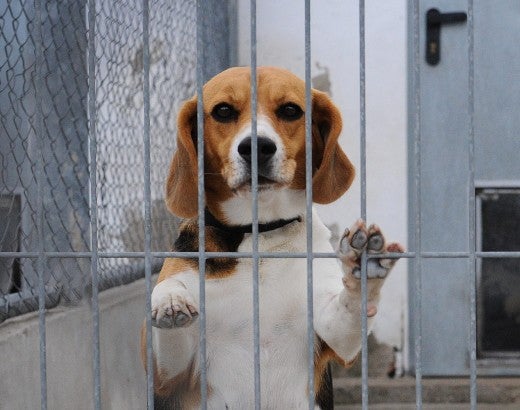
The HSUS publicizes conditions in which beagles are kept for U.S. Army testing of chemical warfare effects; Army agrees to improve conditions for dogs.
The HSUS takes legal action to force the Department of Defense to disclose military usage of animals.