
Sign up to join the fight for all animals with email updates and text alerts—you can be first to take action on the issues that matter most.
Access exclusive content and media materials in our press room.
"A Humane World" is the official blog of the HSUS—a first-hand account of our ongoing efforts to protect animals, as told by our current president and CEO, Kitty Block. Subscribe for daily or weekly updates.

LOS ANGELES ―Today, the Humane Society of the United States released an undercover investigation identifying a handful of California retailers openly skirting the law by selling new fur products. Assemblymember Laura Friedman authored Assembly Bill 44, which passed in 2019 and makes it illegal to...
The Humane Society of the United States has released its annual Protein Sustainability Scorecard, which assesses the efforts of top U.S. food service companies to reduce their impact on the environment and animals through purchasing and menuing practices. The companies included in this report are...
TRENTON, New Jersey—State Senators Brian Stack, D-Hudson, and Raj Mukherji, D-Jersey City, and Assemblywomen Shama A. Haider, D-Englewood, and Luanne M. Peterpaul, D-Asbury Park, have introduced legislation that will prohibit the sale of dogs, cats and rabbits in pet shops, effectively cutting off...
This week the Humane Society of the United States assisted law enforcement with the rescue of over 120 dogs from an alleged dogfighting operation throughout multiple properties in Cumberland County, New Jersey. Humane Rescue Alliance and licensed veterinarians also assisted on-scene. Law enforcement...
The Humane Society of the United States is offering a reward of up to $5,000 for information leading to the identification, arrest and conviction of the person or persons responsible for starving a dog and then dumping the dog’s remains in a river. The Case: According to the Clay County Sheriff’s...
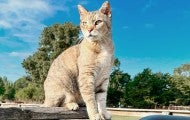
Around a decade ago, Black Beauty Ranch staff members found a tabby cat wandering the property. The HSUS sanctuary had hundreds of animals—including horses, pigs, bison and tigers—but a domestic cat was an odd sight. After realizing she had likely been dropped off by someone who could no longer care...
When animals join the sanctuary together, caregivers generally decide on a name theme. Recent macaque rescues Hopper and Max were named for characters on the Netflix sci-fi drama Stranger Things; kangaroos Ross, Rachel and Joey are as bonded as the crew from the sitcom hit Friends; lemurs Sprout and...
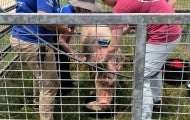
Maggie the pig was abandoned on an island in a river, then rescued after a flood. First, she nearly starved. Then, she nearly drowned. When Maggie arrived at Black Beauty Ranch in March 2023 at age 2, caregivers hoped to give her a life that would make up for all the suffering. But the pig, bred to...
WASHINGTON (March 29, 2024) — Today, the U.S. Fish and Wildlife Service announced a final rule governing import permits for live African elephants and elephant hunting trophies. This action effectively bans elephant hunting trophy imports from certain countries that serve as major destinations for...

In a quiet corner of Black Beauty Ranch, on a stone plinth beneath a maple tree, there’s an oval etching of a man and a burro. The man is Cleveland Amory, author and founder of the Fund for Animals, and the burro is Friendly, one of the first animals to call the sanctuary home. The two met in 1980...
